
EDITOR’S NOTE: The author of this article used AI-assisted tools in its composition, but all content, analysis, and conclusions were based on the author’s professional judgment and expertise. The article was then edited by a human being.
Buried in recent headlines was what may become one of the most significant healthcare-related data breaches in U.S. history: the ransomware attack on Conduent, a major government technology contractor.
Conduent processes Supplemental Nutrition Assistance Program (SNAP) transactions and supports government healthcare programs nationwide. Their systems reportedly touch data tied to more than 100 million people. Early last year, a ransomware group infiltrated their environment and remained undetected for 84 days.
Blue Cross Blue Shield of Montana (BCBSMT) was contracted with Conduent and was notified that it was an impacted client in January 2025. However, BCBSMT informed impacted individuals in October 2025 – nine months after learning of the incident (Security 2026). For many patients, notification letters began arriving in mailboxes only at the very end of 2025, nearly 11 months after the fact.
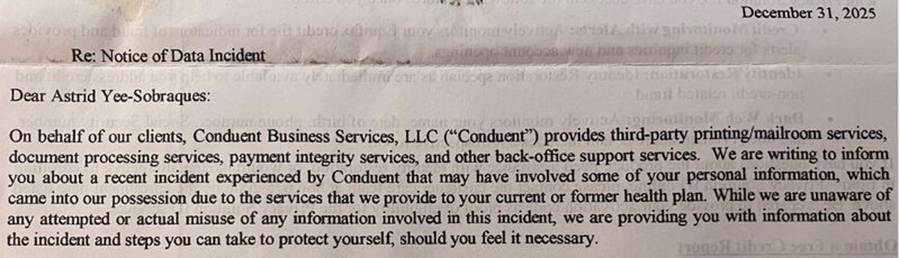
Source: LinkedIn, Astrid Yee-Sobraquès
What initially sounded like a “limited incident” now appears to have affected at least 25 million individuals, making it the eighth-largest healthcare-related cybersecurity breach in U.S. history.
In Texas alone, 15.4 million residents were involved – nearly half the state’s population. Oregon reports another 10.5 million. Other states are still notifying residents. The final number may climb even higher.
The stolen data reportedly includes names, Social Security Numbers, medical information, and health insurance details.
For health information management (HIM) professionals, that combination should set off alarms.
This isn’t credit-card data. This is identity-layer data, with permanent identifiers that cannot be reissued like a debit card. Social Security Numbers and medical histories enable identity theft, medical fraud, insurance billing abuse, prescription diversion, and highly targeted scams. Healthcare data remains among the most valuable commodities on the black market because it enables long-term exploitation. Consider the following:
- Black-market estimates for stolen medical records go for $260–$310, roughly 10 times the value of a stolen credit card number. (Patient Protect, 2025)
- Individual victims of medical ID theft may incur thousands in resolution costs (roughly $13,000+ average out of pocket is required to resolve identity fraud cases). (NEAMB, 2026)
- Medical identity theft contributes to an estimated $30 billion+ in healthcare fraud losses annually in the U.S., per one industry estimate. (NEAMB, 2026)
But here is where this becomes more than a cybersecurity story.
It is a governance story.
It is an enterprise risk management story.
And it is fundamentally a stewardship story.
Most organizations view data as an asset: something collected, processed, exchanged, and leveraged. But after a breach, that same data instantly becomes a liability.
And to the individual? That data is not an asset or liability.
It is their identity.
The 84-day dwell time and 11-month notification lag expose something deeper than a technical vulnerability. They expose systemic blind spots: vendor oversight, contract language, monitoring protocols, breach rehearsal, and board-level accountability.
Conduent is a third-party processor. Many impacted individuals likely had no idea their data was stored there. This is the modern privacy challenge: your defensive perimeter ends at your organizational boundary, but your stewardship does not.
When a breach occurs, organizations pay notification costs, legal fees, regulatory fines, and public-relations expenses. When an individual’s data is compromised, they may manage the consequences for decades.
That distinction should influence how we think about vendor governance.
The envelope arriving in someone’s mailbox is a lagging indicator. By the time that notification arrives, every meaningful decision has already been made: vendor selection, contract negotiation, risk scoring, due diligence, audit rights, cyber insurance coverage, and board reporting.
The real organization-level question is not “How do we prevent a breach?”
The question is: “Who in this room is accountable for the 25 million people holding that envelope?”
In healthcare, HIM professionals sit at the intersection of compliance, privacy, security, and operational integrity. That position carries strategic influence. We are not simply custodians of records. We are stewards of identity-layer information in an increasingly outsourced, vendor-dependent ecosystem.
Jennifer Mueller, AHIMA’s Vice President, recently stated that “the health information profession is positioned at the center of healthcare transformation.” This breach demonstrates the need for our involvement in transforming the privacy and cybersecurity environment and protecting our patients’ data.
HIM, billing and patient care providers will be at the front line of identifying medical identity red flags with:
(1) Patient inquiries to access their records (and to find out who else accessed them);
(2) Inquiries such as “Why did I receive a bill for a cholecystectomy that I never had?” (a clear red flag); and
(3) Patient comments such as: “Oh, B- is not my blood type. I don’t know where that came from. My blood type is O.”
HIM professionals can demonstrate their awareness of what’s hitting and not hitting the headlines by sharing this type of information and guidance with organizational leadership, to help inform next steps and mitigation practices.
The Conduent breach is not just another ransomware headline.
It is a case study in third-party risk concentration, breach detection lag, notification delay, and the widening stewardship gap between organizations and individuals.
Closing that gap requires stronger vendor governance, continuous monitoring, contract accountability, executive reporting, and board-level rehearsal of breach scenarios before, not after, the envelope is mailed.
Because in today’s environment, cybersecurity is not just an IT function.
It is a HIM leadership responsibility.
Sources:
Fox News: Kurt Knutsson, CyberGuy Report. Conduent ransomware breach allegedly affects millions across states | Fox News. https://lnkd.in/eW54CHvN 2/22/26
LinkedIn Posts: 2/23/26-2/25/26: Michael Kwinana, Eva Benn, Mark H., Astrid Yee-Sobraquès, Anjali Nair
LinkedIn News: Emma W. Thorne. Conduent data breach was far larger than first thought. 2/25/26
National Education Association Member Benefits (NEAMB). 2026. Guard Against the Growing Threat of Medical Identify Theft. https://www.neamb.com/personal-finance/guard-against-the-growing-threat-of-medical-identity-theft?utm_source=chatgpt.com
Patient Protect. 11/4/2025. Healthcare Data Breach Statistics 2025: Why Medical Records Are Worth 10× More Than Credit Cards. https://www.patient-protect.com/post/healthcare-data-breach-statistics-2025-why-medical-records-are-worth-10-more-than-credit-cards?utm_source=chatgpt.com