
Hospitals buy labor, pharmaceuticals, supplies, utilities, insurance, cybersecurity, and food in the same inflationary economy as everyone else. Government reimbursement, however, moves on a different clock.
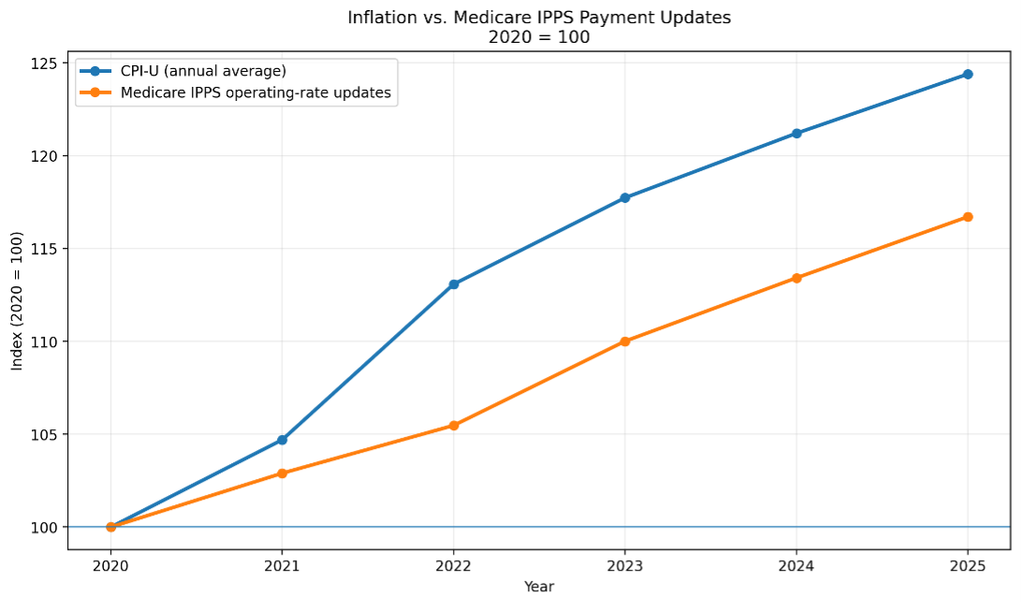
That timing difference has become increasingly important since 2020. Using the U.S. Bureau of Labor Statistics annual Consumer Price Index for All Urban Consumers (CPI-U), overall prices increased approximately 24.4 percent from 2020 through 2025. During the same period, the cumulative Medicare Inpatient Prospective Payment System (IPPS) operating-rate updates for qualifying acute-care hospitals increased only about 16.7 percent.
The Reimbursement Gap
In other words, indexed to 2020 = 100, CPI reached approximately 124.4 by 2025, while cumulative Medicare IPPS operating-rate updates reached only about 116.7. The 7.7-percentage-point difference is not merely an accounting curiosity. It represents lost purchasing power.
CPI and the Medicare hospital market basket are not identical measures. Medicare payments are also affected by wage indexes, MS-DRG recalibration, Disproportionate Share Hospital (DSH) payments, quality programs, geographic adjustments, and other factors. But the direction is clear: hospital costs have accelerated faster than the headline Medicare update.
The Productivity Adjustment Makes the Gap Wider
The Centers for Medicare & Medicaid Services (CMS) does not simply give hospitals a projected hospital market-basket increase. Federal law requires a productivity adjustment. For the 2026 fiscal year (FY), CMS projected that hospital input prices would increase 3.3 percent, but reduced the update by 0.7 percentage points, producing a 2.6-percent IPPS increase. For FY 2027, CMS projected a 3.2-percent market-basket increase but finalized a 2.3-percent update after a 0.9-percentage-point productivity reduction.
In effect, hospitals are expected to offset part of inflation through productivity. That is more difficult when nursing salaries, pharmaceuticals, technology, insurance, and purchased services are rising simultaneously.
Medicaid May Be an Even Bigger Problem
There is no national Medicaid hospital rate comparable to Medicare IPPS. States use different base-payment methodologies and then layer on DSH payments, supplemental payments, uncompensated-care pools, and managed-care directed payments. The Medicaid and CHIP Payment and Access Commission (MACPAC) has repeatedly documented substantial state variation and base payments that often fall below hospital costs.
Inflation becomes particularly damaging when Medicaid rates are built on old cost years. If a state starts with a historical $10,000 cost base that is already understated, a later 3-percent increase does not restore adequacy. It simply pays 103 percent of an inadequate number. For reimbursement professionals, the essential question is: what year is underneath the rate?
Measure Purchasing Power, Not Nominal Dollars
Hospitals should compare cumulative reimbursement growth with cumulative expense growth separately for traditional Medicare, Medicare Advantage (MA), Medicaid fee-for-service, Medicaid managed care, and commercial insurance.
A service that once paid $17,000 and now pays $20,000 appears to have received a substantial increase. But if the cost of furnishing that service increased from $16,000 to $21,000, the hospital did not gain $3,000. It lost $1,000.
After several years of elevated inflation, the reimbursement question is no longer simply whether Medicare or Medicaid rates increased. The question is whether those payments still purchase enough labor, supplies, technology, and services to deliver the care policymakers expect hospitals to provide.
EDITOR’S NOTE:
The opinions expressed in this article are solely those of the author and do not necessarily represent the views or opinions of MedLearn Media. We provide a platform for diverse perspectives, but the content and opinions expressed herein are the author’s own. MedLearn Media does not endorse or guarantee the accuracy of the information presented. Readers are encouraged to critically evaluate the content and conduct their own research. Any actions taken based on this article are at the reader’s own discretion.